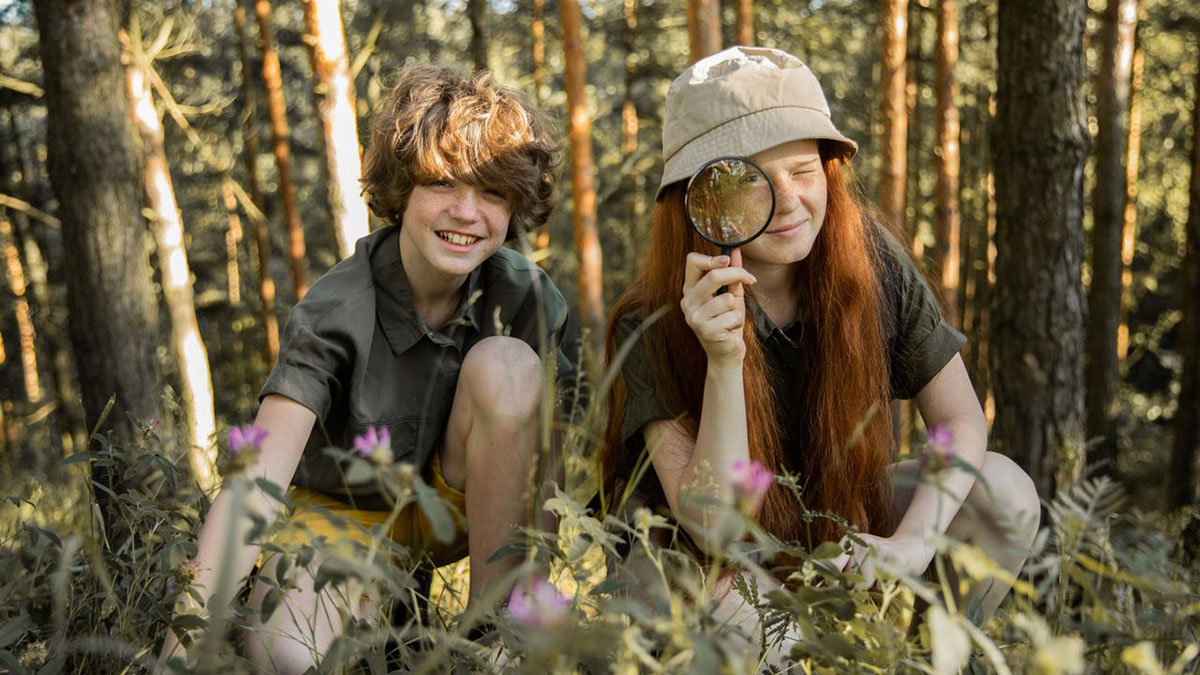
Mobile escape room – Bringing the game to the participants
A mobile escape room can easily be taken beyond a permanent room. Boxes, locks, envelopes, puzzles, electronic devices and other objects can be transported and set up at schools, camps, events or youth programmes. The story can be adapted to the location: participants may search for missing equipment in a forest camp, decode a secret message at a historical site, or complete an environmental research mission. Outdoors, finding the location of the next clue can become part of the challenge itself.
Treasure hunts – Expanding the escape room
Treasure hunts are one of the simplest ways to transfer the escape-room experience outdoors. Participants move between locations following a story or sequence of tasks, with each clue bringing them closer to the final goal.
Maps, compasses, GPS, natural landmarks and hidden objects can be combined with QR codes, photographs, codes or electronic devices. Treasure hunts are particularly effective for environmental education: participants can identify plants, examine stream water, count species or record observations on a map. In this way, the game encourages them not only to enter nature but also to observe, measure and act.
Moving competition (Station Race) – Combining thinking with movement
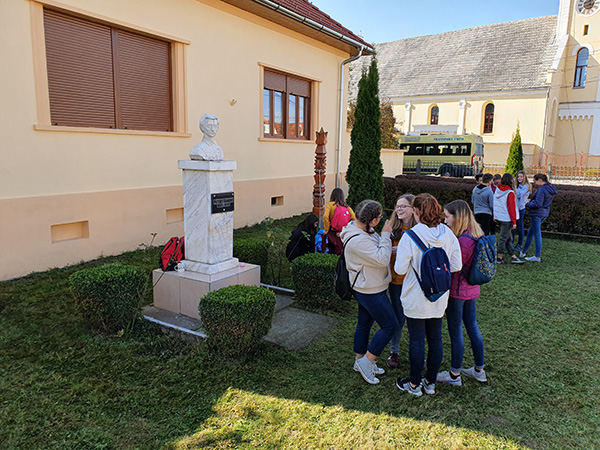
A moving competition is a multi-station game in which participants follow a defined route and complete different tasks at each station. These may include code-breaking, target throwing, navigation, memory challenges, nature questions or logic puzzles.[6] Our own games include history-themed moving competitions, nature quizzes and geographical games. Their main strength is the combination of cognitive and physical activity: participants think, move, navigate, communicate and make decisions.
Obstacle and assault courses – The role of physical challenge
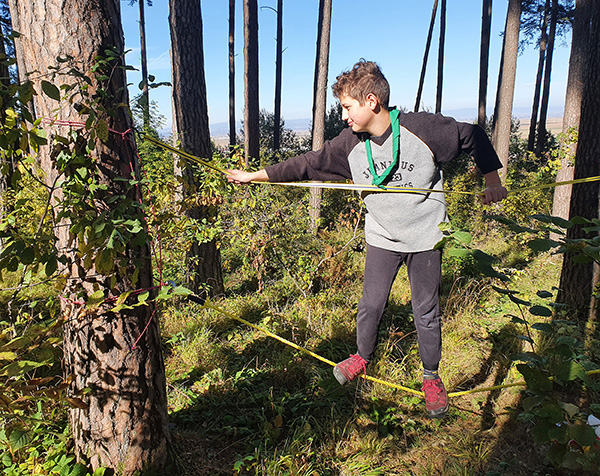
Obstacle and assault courses primarily involve physical challenges, but escape-room mechanics can easily be incorporated. After completing each obstacle, teams may receive a number, letter or symbol that contributes to a final code. Physical performance thus becomes directly connected to logical problem-solving. Embedding the course in a story makes the experience more engaging. Participants may become an expedition team, rescue unit or group of explorers completing a shared mission. Such courses also encourage cooperation: one participant may give instructions, another complete the physical task, while a third collects information. Scouting similarly uses outdoor games and obstacle courses to develop coordination, communication and teamwork.[7]
Educational opportunities
Outdoor escape-room-like games combine problem-solving, creativity, communication, cooperation and physical activity. Participants must often make decisions, divide tasks and develop strategies within a limited time.[8] Challenges should always be adapted to their age and abilities. In Transylvania, similar approaches are used by the Transylvanian Carpathian Association – Erdélyi Kárpát-Egyesület (EKE), scouting organisations, universities and schools. Although their aims and methods differ, they share an experiential approach in which participants actively move, search, observe, solve problems and cooperate.[7] The escape room can therefore be understood not simply as a physical room but as a playful methodology. The “room” may be a forest, museum, university campus or hiking route; a key may be a GPS coordinate, and a door may be a coded message. What matters is the experience and the participant’s active role.
Conclusion
An escape room does not have to be confined by four walls. Its core principles – the story, challenge, puzzle, time limit, cooperation and pursuit of a goal – work equally well outdoors. Outdoor escape-room-like games are more than traditional escape rooms moved outside. They are complex experiential learning environments in which participants think, move, explore, cooperate and make decisions. This makes them especially valuable in education, camps, youth programmes, environmental education and team building.
References
[1] Clarke, S., Peel, D., Arnab, S., Morini, L., Keegan, H., & Wood, O. (2017). EscapED: A Framework for Creating Educational Escape Rooms and Interactive Games for Higher/Further Education. International Journal of Serious Games, 4(3), 73–86.
[2] Fotaris, P., & Mastoras, T. (2019). Escape rooms for learning: A systematic review. European Conference on Games Based Learning, 235–243.
[3] Stathakis, G. (2020). Treasure Hunts as Learning Activities: Benefits and Implementation Strategies. Journal of Education and Learning, 9(2), 92–101.
[4] Deterding, S., Dixon, D., Khaled, R., & Nacke, L. (2011). From Game Design Elements to Gamefulness: Defining “Gamification”. Proceedings of the 15th Academic MindTrek Conference, 9–15.
[5] Huizinga, J. (2004). Homo Ludens: A játék társadalmi jelentősége. Budapest: Osiris Kiadó.
[6] Uzuner, F. G., & Bektaş, F. (2024). Examination of Teachers’ Views on the Use of Orienteering in the Education Process. International Primary Educational Research Journal, 8(1), 54–71.
[7] Kovács Lehel István. Szabadulószobák: gamifikáció az informatika és matematika oktatásában. XXVI. Enelko – XXXV. SzámOkt, EMT.
[8] Chen, J., He, M., & She, S. (2025). The impact of environmental serious game on pro-environmental behavior through environmental psychological ownership and environmental self-efficacy. Scientific Reports, 15(1), 27616.
[9] Lim, W. M., Das, M., Sharma, W., Verma, A., & Kumra, R. (2024). Gamification for sustainable consumption: A state-of-the-art overview and future agenda. Business Strategy and the Environment, 34(1), 1510–1549.